
Home/Work/Memorial design studio
Memorial design studio
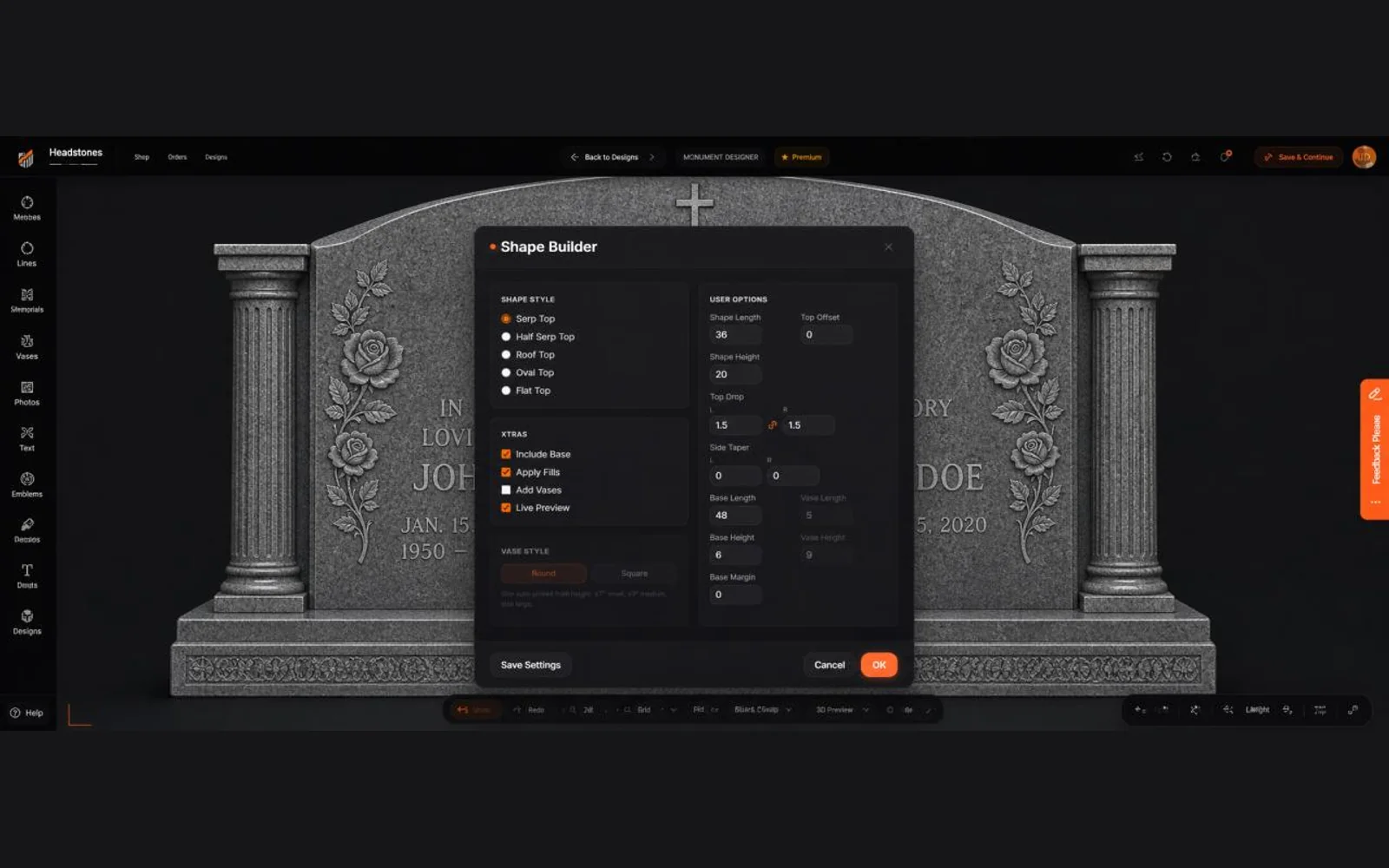
A design studio inside a monument manufacturer's platform. Five parametric shape families in real inches, a hand-written granite shader, per-object engraving depth, and output the workshop can run without redrawing it.
The situation
A monument manufacturer sold through a network of retailers. Every memorial was drawn by hand by their design team from an emailed sketch, revised over several rounds, then redrawn again before it could be made. The bottleneck was not demand — it was drawing capacity.
What we built
- A browser design studio embedded in the company's existing platform
- Five parametric shape families — serpentine, oval-top, flat, teardrop and custom — driven by real inch dimensions rather than fixed templates
- A hand-written granite shader reproducing polished, honed and rough-cut finishes across the full material range
- Per-object engraving depth, so lettering, ornament and photo panels each carry their own cut depth
- Text layout with monument-appropriate typography, converted to outlines on output
- Production output with closed paths and layer separation, straight from the approved design
Engineering notes
The engineering difficulty was not the 3D preview — it was making one geometry definition serve both the customer-facing render and the production output. Both read from the same parametric model, so the preview and the manufactured part cannot drift apart. The granite shader was written rather than configured because off-the-shelf materials could not reproduce the speckle and depth of polished stone convincingly enough for customers to trust the preview.
Tell me what your customers should be able to design.
If your process today is an email, a sketch, and somebody rebuilding it by hand afterwards — that's the problem I work on.
or email [email protected]